VirtualKD |
Welcome to the VirtualKD homepage. This project allows speeding up (up to 45x) Windows kernel module debugging using VMWare and VirtualBox virtual machines. If you have ever noticed that the standard debugging over virtual COM port is irritatingly slow, this software is for you!
Normally, debugging over a virtual COM port involves the following scheme:The weakest link in this scheme is the virtual COM port, as its speed is limited to 115200 bits per second, i.e. around 10 KB/s. VirtualKD replaces the virtual COM port-related functionality, significantly raising the exchange rate (!irpfind produces ~450KB/s traffic on VirtualBox and ~150KB/s on VMWare, significantly outperforming standard ~10KB/s COM Port). Basically, VirtualKD consists of a Windows KD extension DLL and a patch to VMWare and VirtualBox processes, that create named pipes on host. This allows debugging Windows drivers on virtual machines using stadard tool set (WinDBG/KD), but with significantly lower response times.
New in version 2.1: Now fully compatible with Windows 7 (both host and guest), supports VirtualBox 3.x, and includes a fully automatic guest machine installer.
New in version 2.0: Added support for VirtualBox and fixed rare x64 loading bugs.
Attention! To use VirtualKD with VirtualBox 3.1.x, you need the following patch.


VirtualBox: the latest 3.0 branch is supported. You can rebuild VirtualKD from sources using VirtualBox headers to support other versions. The following version was tested:
If you are using VirtualBox, please do the following steps prior to doing anything with your VMs:

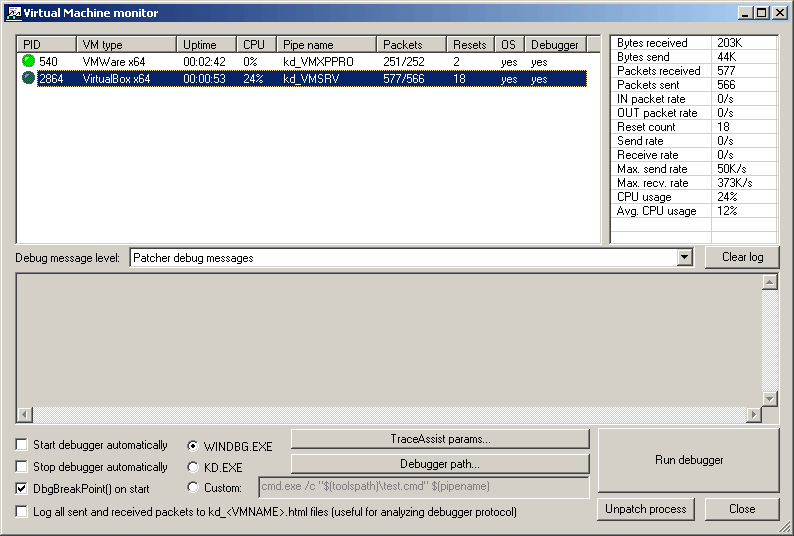
VirtualKD installer works with both pre-Vista operating systems (Windows XP, Windows Server 2003) and Vista-family (Windows Vista, Windows 7). After installing VirtualKD to the virtual machine, simply run the vmmon.exe on host machine and restart the Virtual Machine. VMMon will launch WinDbg with the corresponding parameters automatically.
If automatic installation has failed, there still are 2 manual ways of installing VirtualKD on a virtual machine:
A) Dynamic patching (not recommended).
Copy both KDPATCH.SYS and KDVM.DLL to SYSTEM32\DRIVERS directory of your virtual machine
(yes, both DLL and SYS in the same place) and apply the KDPATCH.REG file (or manually create a legacy driver
running KDPATCH.SYS). Then, perform the following sequence:
1) Start the virtual machine
2) BEFORE OS starts to load, ensure that VMMON.EXE is running (or use
VMXPATCH.EXE) [VMWare only]
3) Start your virtual Windows in a normal debug mode with a virtual COM port
4) Ensure that WinDBG establishes connection (our driver is not involved now)
5) Let the OS boot
6) Wait for the KDPATCH.SYS driver to load (if you set it to manual mode, run
"net start kdpatch"). This will redirect all debugging activity from the COM
port simulated by VMWare to our fast debugging interface (VMWare needs to be
already patched at this moment).
7) Use VMMON.EXE to start WinDbg, or do it manually(The pipe name for the fast debugging is the following:
\\.\pipe\kd_<dirname>, when your VM is located at X:\something\<dirname>\filename.vmx).
8) You can close the first instance of WinDBG.
Alternatively, you can stop the KDPATCH.SYS driver at any moment to direct debug activity
back to the VMWare COM port.
This method is useful if you want to play with the VirtualKD sources and to load different
versions of KDVM.DLL without rebooting the virtual machine. Just start the patcher
service, and the KDVM.DLL is used instead of KDCOM.DLL. Stop it and KDCOM.DLL gains
control back.
B) Static patching (recommended)
1) Copy KDVM.DLL to SYSTEM32 directory of your guest OS. There should already exist
KDCOM.DLL and KD1394.DLL files.
2) Open your boot.ini file. If you are using the COM debugging, you should have a line like this:
4) Reboot your virtual machine and wait for the OS selection dialog.
5) Ensure that VMMON.EXE is running (or use VMXPATCH.EXE) [VMWare only]
6) Use VMMON.EXE to start WinDbg, or do it manulally (use \\.\pipe\kd_<dirname> as pipe name (see above)).
7) Start your guest OS
The /DEBUGPORT=VM parameter in boot.ini instructs Windows to use the
KDVM.DLL file as
the packet layer driver for kernel debugging. This is more flexible than patching KDCOM.DLL,
as it does not require booting in COM debug mode.
Note that if you used KDVMWare 1.x on your VMWare machine, you can continue
using old driver and kernel DLL, or use install the new one. In that case, you
will need to change /DEBUGPORT=VMWare to /DEBUGPORT=VM.
To ensure that all host-side code is loaded correctly, please keep VMMON.EXE running while you are using your virtual machines (it is really important to have it running when a VMWare VM is started). If you are using VirtualBox, VMMON.EXE is not required, as all patching is done manually by renaming VboxDD.dll and copying modified one on its place (see above).
If you have problems with VMMON.EXE, you can try simple
console-based VMXPATCH.EXE.
You can modify some parameters in registry under SOFTWARE\BazisSoft\KDVMWare\Patcher:
AllowPatchingAtTableStart. Set it to 0 if your VMWare crashes when being patched.
AllowReplacingFirstCommand. Set it to 1 if patching fails (and debug output indicates something like "0 free entries").
DefaultPatchingAtTableStart. You can try setting this to increase the performance
(just a bit), but in can make VMWare crash on patching. Feel free to try ;)
Additionally, you can set the WaitForOS to 0 in VirtualKD\Monitor to let the debugger
be started immediately when a VM is detected (without waiting for OS to load).
| v1.0 | |
| Initial version | |
| v1.1 | |
| Fixed handler loss after Virtual Machine reset | |
| Fixed bug with VMWare hanging when no debugger is connected | |
| Added patcher/packet level log displaying in VMMON | |
| Added support for KDCLIENT.DLL unloading from VMMON | |
| Added advanced statistics reporting to VMMON | |
| Added permissive SECURITY_ATTRIBUTES to statistics-related objects to support non-admin VMWare instances | |
| Added debugger command line customization | |
| Added proxy mode support for debug VMMON builds | |
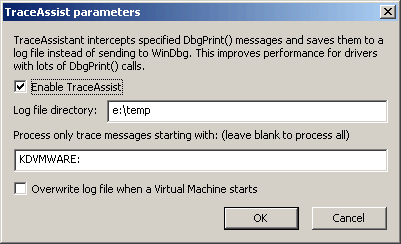
| Added TraceAssist feature | |
| Implemented buffered VMWare GuestRPC resulting in ~1.7x communication speedup | |
| v1.2 | (Only host-side part changed) |
| Fixed rare bug, when disconnecting debugger in the middle of a KdSendPacket() call caused hanging | |
| Reduced CPU usage from 100% to 0% when a VM is active and no debugger is connected | |
| Added workaround for truncated Driver Verifier messages | |
| Added on-demand packet logging feature for easy packet-level KD protocol analyzis | |
| Added API for detecting & patching VMs to KDCLIENT.DLL to support VisualDDK integration | |
| Pipe name is now generated based on VMWARE-VMX.EXE command line, instead of current directory (fix for rare "kd_" pipes) | |
| Added support for sending generated 'Target OS Shutdown' packet when VM is stopping to force debugger to disconnect | |
| Added ",reconnect" option to WinDbg command line, instructing it to reconnect a pipe, when it is closed | |
| (Due to 2 previous features, debugger does not need to be restarted when a VM is restored from a snapshot, while OS is running) | |
| v2.0 | (KDVMWare was renamed to VirtualKD) |
| Added support for VirtualBox | |
| Fixed bug with incorrect x64 VMWare patching | |
| v2.1 | Added support for Windows 7 host and guest machines |
| Added test signature to KDVM.DLL allowing it to run on Vista x64 in TESTSIGNING mode | |
| Added automatic guest machine installer | |
| v2.2 | Improved integration with VisualDDK |
| Added support for VMWARE-VMX-DEBUG.EXE etc. | |
| v2.3 | Fixed memory leak in VMMON |
| Added support for patching VMs from non-administrator accounts via IPC with VMMON | |
| Fixed bug when only first running VM was reported | |
| Added support for VirtualBox 3.1.x |